“That person is like a tree planted by streams of water, which yields its fruit in season and whose leaf does not wither—whatever they do prospers.”
— Psalm 1:3
Over the past year, my view of God has been shifting.
I didn’t grow up with a picture of a gentle, gracious God. I grew up with a sense of a righteously angry one — holy, powerful, easily offended. Mercy is something I’ve only begun to understand in recent years, through recovery and healing and the slow rebuilding of my faith.
Recently, events within my broader spiritual world stirred up old questions again. Questions about justice. About accountability. About what it really means to say God is righteous. I’ve found myself wrestling not only with who God is, but with how His character holds steady in a world where harm is real and sometimes hidden in places that should be safe.
Those questions followed me outside today.
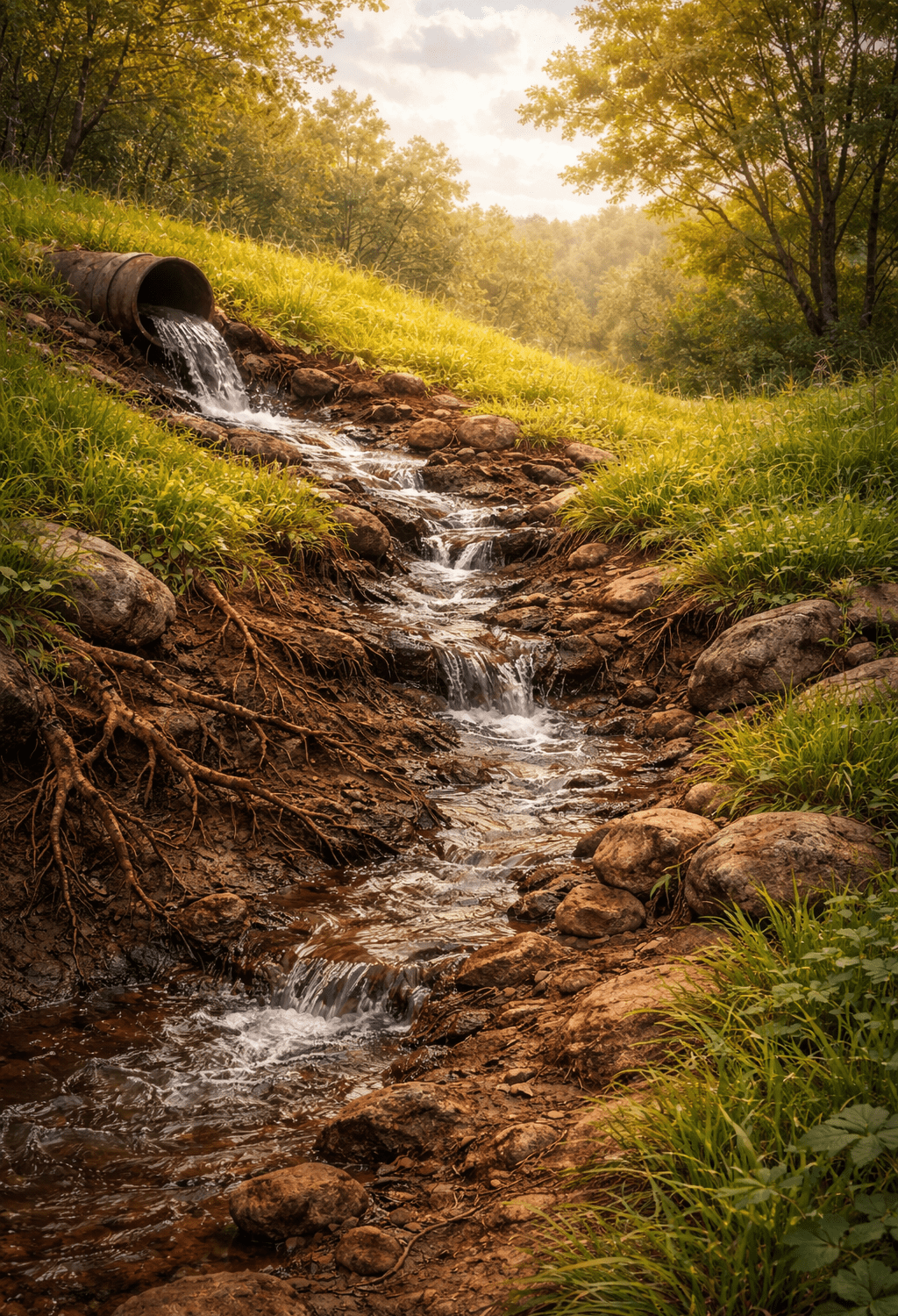
I spent hours working on the overflow from my spring water holding tank.
I started at the bottom of the hill, where the water empties into the creek. It was hard work. I began with a hoe, then added a shovel, then a rake. Eventually I grabbed pruning shears to cut through thick roots that had grown across the channel.
Every time I thought I’d found the natural trickle of water, it disappeared under rocks or tangled roots. I kept hitting rock bed. Progress felt slow. I widened the path more than I expected to, and still I knew I had a long way to go.
It felt familiar.
Trying to fix what I can see.
Trying to manage outcomes.
Trying to clear the mess from the bottom up.
So I changed strategy.
I walked to the top of the hill — to the source. The overflow pipe runs out into thick grass there. It was much easier to cut into that section. With a shovel, I carved a clear path down the slope. The earth was muddy and I nearly got stuck more than once, so I stopped trying to make it perfect. I focused on one thing: creating a clear channel.
When I stopped for the day, the middle section was still flat and unfinished. I knew I would need to work my way back up from the bottom eventually to help the land find its natural slope.
But when I walked down to check the lower section, something had changed.
The water was moving faster.
I hadn’t touched that part again.
All I had done was clear space closer to the source.
And suddenly, what had been slow and scattered was flowing.
The whole time I was working, I kept thinking about how the spring is like God.
The water is constant. The source isn’t the problem.
The blockage happens in the middle.
Roots. Rocks. Years of buildup. Ideas about God that weren’t fully true. Fear-based theology. Spiritual performance. Human systems layered on top of something that was meant to be clear and life-giving.
The grass closest to the overflow pipe is the healthiest part of the yard — green and strong, like the tree planted by streams of water in Psalm 1:3. The lower sections, though, are muddy and oversaturated. Not because there’s no water. But because the water doesn’t have a clear path.
I realized something else, too.
Justice isn’t the opposite of mercy.
And justice is not the same thing as volatility.
The spring doesn’t panic when the channel is blocked. It doesn’t become violent. It doesn’t thrash against the rock in dramatic force. It remains steady. Clear. Consistent.
Righteousness is not aggression.
If anything, chaos often comes from the obstructions — not from the Source itself.
This past year, when my own mind felt unstable… when my faith felt disoriented… when community tensions and hard revelations made everything feel muddy… I had to ask myself whether I was mistaking the mud for the water.
The Source was never chaotic.
The Source was never abusive.
The Source was never complicit.
But the channel — human hearts, institutions, power structures — can become deeply obstructed.
And clearing that is hard, muddy work.
The flow increases when the channel clears near the source.
Not when we widen the muddy bottom.
Not when we work harder downstream.
But when we return upstream and remove what doesn’t belong.
Today I didn’t sit in a sanctuary.
I stood in mud.
I used tools.
I listened to water.
And I felt peace.
It was one of the most honest church services I’ve had in a long time.
When the flow feels blocked, don’t accuse the Source — but don’t ignore the obstruction either.
 Leah McCracken