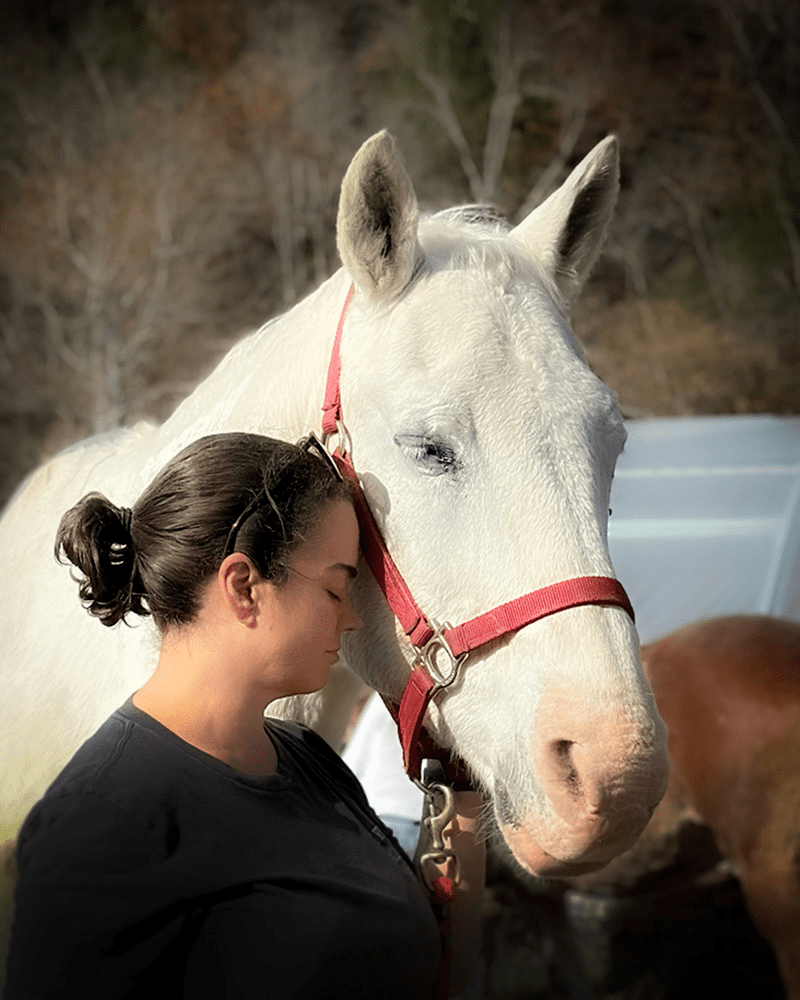
photo credit: Rebecca Bauer
I’m starting to recognize the moment when I override myself.
It’s subtle. There’s no clear line where it happens. Just a shift—something tightens, something goes quiet, and I move slightly out of my own experience and into managing what’s happening around me.
For a long time, I didn’t question that. I thought that was part of being a considerate person. Paying attention. Staying flexible. Keeping things smooth.
But I’m starting to understand that there’s a cost to that.
And I don’t want to keep paying it.
A small example: I had been getting my hair cut, and my stylist had a pattern of reaching across my chest in a way that didn’t feel okay to me.
This time, I didn’t wait for it to happen.
I came in already anxious, already anticipating it. I knew I didn’t want to go through that again, and I knew I needed to say something before it happened.
Even that was hard.
As soon as I brought it up, he pushed back—explaining that it was part of his process.
And almost immediately, I felt myself shift into accommodation.
My breasts are big. I’m used to them being a problem for people. How can I adjust to make this easier for him?
I started offering solutions.
“I can lean forward,” I said.
But he pushed back again.
And something in me snapped—not in a dramatic way, but in a protective one.
“So you can’t check the length without touching my breasts?”
It came out sharper than I expected. A mix of frustration and self-protection.
I’ve been told before that I’m “too friendly”—that people take that as permission to push past my boundaries.
Maybe that’s part of what I was reacting to.
He didn’t argue after that. He just waved me back to the washing area.
And suddenly, there was tension.
I asked a question, trying to smooth things over. That’s my instinct—to repair, to ease, to make sure everything is okay.
But then I stopped myself.
I could feel the urge to keep talking. To soften what I had said. To take responsibility for the awkwardness. To make him more comfortable.
And I didn’t.
I stayed quiet.
It wasn’t peaceful. It wasn’t empowering in a cinematic way. It was uncomfortable. I had to literally talk myself through it in my head. I focused on my breathing while he hummed.
The silence just… sat there.
And I let it.
That’s new for me.
Usually, I would have filled that space. I would have backtracked, or gotten overly friendly, or somehow made it about my body being the issue.
But I didn’t.
We eventually went back to the chair and finished the haircut.
He didn’t bring it up again. He didn’t check the length. He kept a respectful distance.
And when I left, I noticed something.
I felt calmer.
Not because the interaction was perfect—it wasn’t.
Not because it was easy—it definitely wasn’t.
But because I didn’t have to carry the weight of it anymore.
I didn’t have to anticipate it happening again.
I didn’t have to manage it internally.
That’s what I’m starting to understand about safety.
It’s not just about whether something is physically dangerous.
It’s about whether I can stay at ease in my own body.
Whether I trust that my space will be respected.
Or that I will respect it, even when it’s hard.
I’m still learning how to do this.
It doesn’t come naturally to me. My default is to accommodate. To adjust. To make things easier for other people—even at my own expense.
So speaking up is hard.
And not over-repairing afterward might be even harder.
But I’m starting to see this pattern more clearly—not just here, but across different parts of my life.
The moments where I smooth something over.
Where I wait for clarity that isn’t coming.
Where I explain away what I already feel.
I’m not doing that anymore.
I’m learning to notice when something doesn’t feel right.
And to stay with myself in that moment—without rushing to fix it, soften it, or make it easier for someone else.
Because safety, for me, isn’t just about what happens around me.
It’s about whether I stay on my own side when it does.
 Leah McCracken